
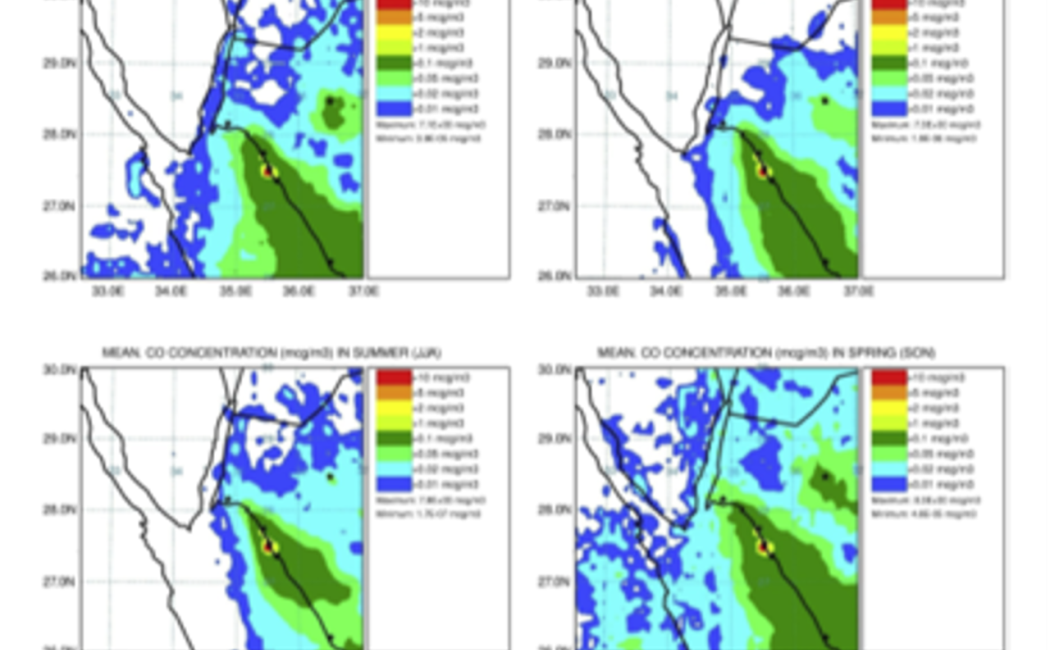
Quantification and monitoring CO2 emissions are particularly important to plan and adopt future emissions strategies. Recent studies have demonstrated the capabilities of satellite measurements in monitoring the changes in CO2 emissions at seasonal to interannual scales (e.g., Nassar et al., 2017). We propose to analyze the long-term CO2 concentrations over NEOM using high-resolution Orbiting Carbon Observatory (OCO) and ESA-CCI satellite measurements in order to identify the main emission sources of CO2 in and around the region. The emission rates of the identified CO2 hotspots will be estimated based on a Gaussian plume model. A high-resolution Weather Research Forecasting – Green House Gas (WRF – GHG) model (Beck et al., 2011) simulations will be implemented to estimate the contributions (in percentages, %) of the local and regional sources to the total CO2 concentrations observed over NEOM. We have been extensively using the WRF modeling framework for simulating different atmospheric and air pollution phenomenon over the Red Sea region (e.g., Hoteit et al., 2021), including in the NEOM region (Figure1, Dasari et al., 2020). We will then use the satellite measurements together with the model outputs to examine the CO2 variability over the NEOM region. This will be also complemented by vertical profiles of CO2 concentrations available from the In-service Aircraft Global Observing System (IAGOS) to understand the vertical distribution of CO2 over the region. Both the high resolution KAUST Red Sea atmospheric reanalysis and the coarser 5th-generation ECMWF global atmospheric reanalysis (ERA-5) will be further analyzed to understand the role of large-scale climate patterns on the regional CO2 variability over NEOM.
Task-I. Identify the main sources of CO2 in NEOM and quantify the spatiotemporal characteristics of their emissions based on the satellite measurements
Task-II. Investigate the contributions of local and neighbouring sources to the CO2 concentrations over NEOM using a chemistry-transport mode
Task-III. Study spatiotemporal variability of CO2 over NEOM at seasonal and interannual scales in relation to the atmospheric circulation
Task-IV. Interactive Visualization Dashboard