
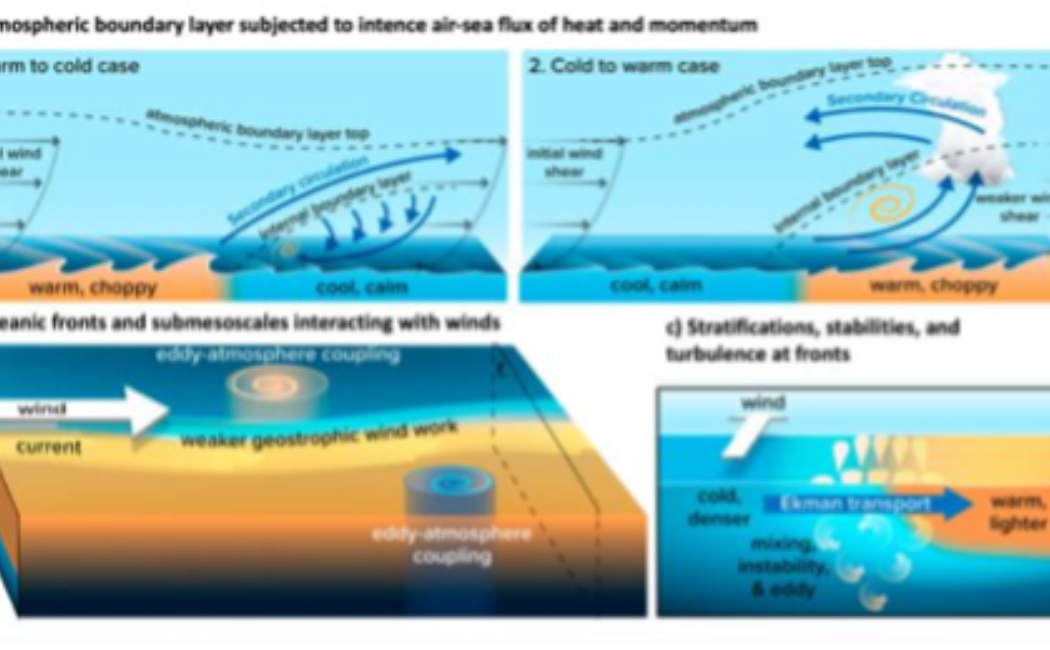
Previous research has highlighted the critical role of submesoscale processes in modulating vertical heat flux and air-sea interactions in the upper ocean. However, a detailed understanding of the mechanisms driving these interactions and their feedback effects on regional climate remains quite limited. This project aims to elucidate the complex interactions between the ocean and atmosphere at submesoscale levels, and reveal their role on climate implications, using the AS as testbeds. By developing advanced modeling techniques, applying geophysical fluid dynamics theories, and conducting rigorous statistical analyses, this project seeks to advance understanding of these processes. The insights gained from this research will also support sustainable marine resource management and conservation strategies, helping to reduce environmental impacts and enhance resilience to climate variability in the region.
The proposed research aims to:
a) Develop state-of-the-art high-resolution air-sea coupled numerical models for the AS with dynamically balanced downscaling configurations of global climate models and parameterization schemes tailored for submesoscale processes.
b) Quantitatively assess submesoscale processes’ impacts on air-sea momentum and heat fluxes, and conduct targeted process studies to isolate mechanisms through which submesoscale processes impact broader scale dynamics and regional climate feedback.
c) Investigate submesoscale variabilities at diurnal scales and their impact on the longer-term evolution of oceanic frontal processes, vertical flux, and horizontal chaotic stirring.
d) Examine the response and impact of submesoscale processes under varying environmental conditions and project future changes in submesoscale characteristics by downscaling global climate simulations under different Shared Socioeconomic Pathway (SSP) scenarios such as SSP126 and SSP585.