Mapping the hidden connections that sustain reef resilience in a rapidly transforming coastline
Saudi Arabia’s coastline is undergoing an unprecedented transformation. Driven by Vision 2030, rapid development along the Red Sea is positioning the Kingdom as a global hub for high-end tourism. Yet, a critical gap remains: coral reef management and Marine Protected Area (MPA) planning are advancing without a clear understanding of how reef populations across the Saudi Arabian Red Sea (SARS) are genetically connected.
This project addresses that challenge by uncovering the hidden links between coral populations—connections that are essential for effective conservation, restoration, and long-term resilience.
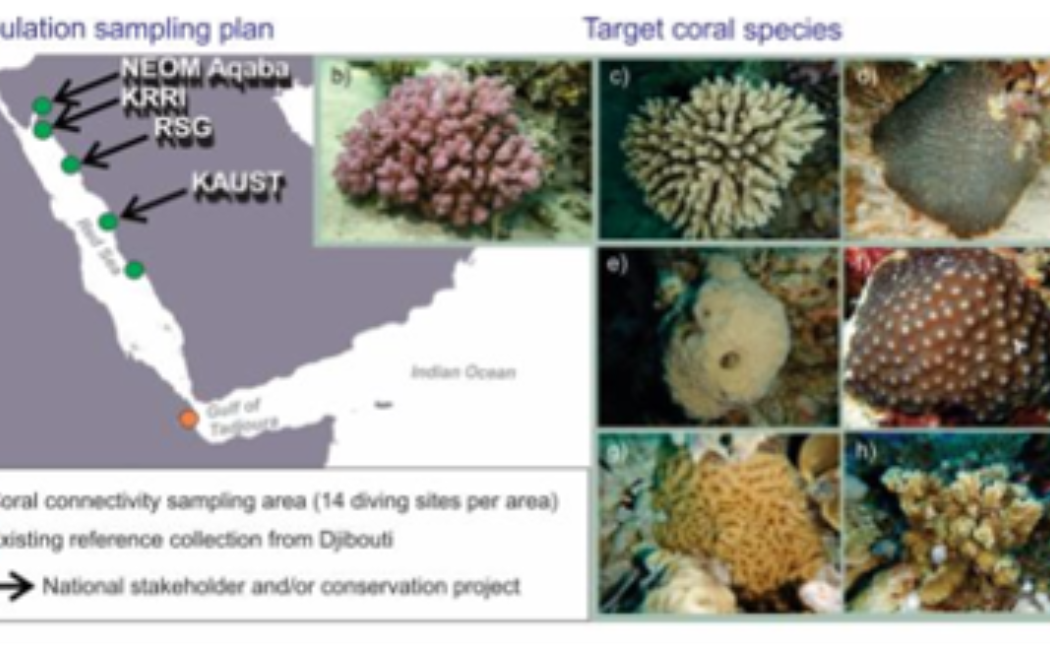
Scope. Focusing on seven reef-building coral species across five key regions—Gulf of Aqaba, Shushah Island, Al Wajh, Thuwal, and Al Lith—we will analyze around 700 samples to map genetic connectivity patterns.
Approach. Using advanced genomic techniques, we will identify how populations are connected, where barriers exist, and which reefs act as critical “source” or “sink” systems.
Symbiosis. In parallel, we will examine the diversity of symbiotic algae (Symbiodiniaceae) that underpin coral health and explore how these communities relate to connectivity patterns.
Modelling. These insights will feed into a Red Sea connectivity model simulating coral larval dispersal based on ocean circulation—scalable to the entire basin.
By linking genetics, ecology, and ocean dynamics, this project delivers the knowledge needed to guide science-based decision-making—ensuring that development and conservation progress hand in hand for the future of Red Sea ecosystems.